
A classroom that only rewards correct answers produces students who are afraid to think. A classroom that rewards good thinking produces students who can find answers, even to questions no textbook has yet addressed.
Introduction

Ask most students in a Nigerian classroom a question that has a single correct answer, and they will compete to give it. Ask those same students a question that requires them to weigh two competing ideas, make a reasoned judgment, or defend a position with evidence and the room often goes quiet.
This is not a failure of intelligence. It is a failure of practice. Most students have been rewarded, for the majority of their schooling, for recalling correct answers, not for the quality of their reasoning. They have been trained to identify what the teacher wants to hear rather than to think independently about what they actually believe, and why. The result is a generation of students who are extremely good at memorisation and considerably less practised at analysis, evaluation, and independent judgment.
Critical thinking is the ability to analyse information, identify assumptions, evaluate evidence, and arrive at reasoned conclusions, is not an innate talent. It is a skill that develops through repeated practice, in classrooms that deliberately create space for it. The five strategies below show you how to create that space, in any subject, at any level, without special resources or extra preparation time.
And here is the most important thing to understand before you begin: you do not teach critical thinking by explaining what it is. You teach it by designing moments in your lessons where students have no choice but to use it.
The goal of education is not to fill a student’s head with facts. It is to build a mind that knows what to do when the facts run out. – Adapted from John Dewey
| Critical thinking ranked by employers Top 3 consistently, across Nigerian and global graduate employer surveys | Most classroom questions are Recall research shows over 70% of teacher questions require only memory, not thinking | Critical thinking is Learnable it improves significantly with deliberate, consistent classroom practice |
Recall-focused classrooms vs thinking-focused classrooms
| Recall-focused classroom | Thinking-focused classroom |
| Questions have one right answer — memory retrieval only | Questions invite analysis, judgment, and reasoned argument |
| Wrong answers end the exchange — no exploration | Wrong answers become starting points for exploration |
| Students wait to be told what to think | Students form and defend their own positions |
| Success means matching the expected answer exactly | Success means clear reasoning, even if the conclusion differs |
| Teacher holds all the authority — students receive it | Teacher facilitates, students generate and evaluate ideas |
Five strategies that build critical thinking in any classroom
1. Upgrade your questions: move up Bloom’s taxonom
Benjamin Bloom’s taxonomy of educational objectives remains one of the most useful frameworks in teaching because it maps the full range of cognitive demand, from simple recall at the bottom to evaluation and creation at the top. Most classroom questions cluster at the bottom two levels: remembering and understanding. Critical thinking lives in the upper levels: applying, analysing, evaluating, and creating. Moving up the taxonomy does not require abandoning foundational questions, it means adding a higher-order question after the recall question has been answered. “Who was the first president of Nigeria?” is recall. “What do you think was the most important decision Tafawa Balewa made in his first year and why?” is evaluation. The second question requires the same knowledge as the first, plus the ability to weigh, judge, and argue. Both belong in your lesson. The second one is what builds the skill.
Try it: For your next lesson, write one question at each of the top three Bloom’s levels; apply, analyse, evaluate and use at least one during the session.
2. Use “why” and “what if” as your most powerful teaching tools
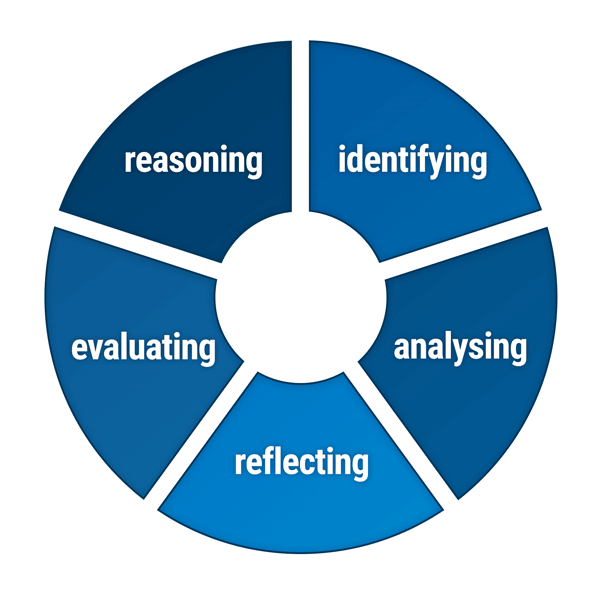
Two question words unlock critical thinking more reliably than any others. “Why” pushes a student past the surface of their answer, past the fact they have remembered into the reasoning behind it. “What if” dismantles assumptions by inviting students to imagine how the situation would change if a variable were different. In a history lesson: “Why did Nigeria’s military leaders justify their first coup in the way they did?” followed by “What if the 1966 coup had not happened, how might things have been different?” In a science lesson: “Why does metal expand when heated?” followed by “What if metals had different expansion rates at the same temperature, how would that affect bridge construction?” Neither question requires special equipment or materials. Both require students to think rather than recall and that is the entire point.
Try it: After your next recall question gets an answer, follow it with “why do you think that is?” and wait for a full response before moving on.
3. Teach students to argue both sides
One of the most effective critical thinking exercises is asking students to argue for a position they do not personally hold, or to argue both sides of the same issue before forming a conclusion. This builds the ability to understand a perspective different from one’s own, to identify the strongest version of a counter-argument, and to make decisions based on evidence rather than instinct. In a civic education lesson, present a genuine policy dilemma and ask half the class to argue for it and half against, then swap. In a literature lesson, ask students to defend a character’s decision before critiquing it. In a business lesson, present a real company decision and ask: “Build the strongest case for this decision. Now build the strongest case against it.” The skill developed which is the ability to hold two competing ideas in mind simultaneously and reason between them is one of the most valuable a student can leave school with.
Try it: Choose one controversial topic from your current unit. Ask students to write two sentences arguing FOR it and two sentences arguing AGAINST it, before sharing their personal view.
4. Model your own thinking aloud
Students learn critical thinking not only from being asked to do it, but from watching a skilled thinker do it in front of them, including making mistakes, revising a conclusion, and explaining why. Think-aloud modelling means narrating your own reasoning process as you work through a problem: “I am looking at this question and my first instinct is to say X, but then I notice that Y contradicts that, so I need to reconsider…” This kind of transparency shows students that good thinking is not always linear, that uncertainty is part of the process, and that revising a position in the light of new evidence is a sign of strength rather than weakness. It also demystifies the process: students who have seen a teacher think critically are better equipped to attempt it themselves, because they now have a model for what it looks like when done well.
Try it: In your next lesson, work through one problem out loud narrating your thinking, including your uncertainties and revisions, before arriving at a conclusion.
5. Create a classroom culture where questioning is safe
No critical thinking strategy will work in a classroom where students fear being wrong. Asking students to analyze, evaluate, and form independent judgments requires them to take intellectual risks and intellectual risk-taking only happens when the cost of being wrong is low. This means responding to wrong answers or uncertain ideas with curiosity rather than correction: “Interesting, what led you to that conclusion?” rather than “No, that is incorrect.” It means celebrating the quality of reasoning independently of whether the conclusion is right: “I like how you weighed the two options before deciding, can you explain that reasoning further?” It means normalizing uncertainty by voicing your own: “I am not entirely sure about this, actually, what does the class think?” A classroom where students feel safe to be wrong is a classroom where students are willing to think and thinking, repeated and practiced, is where critical reasoning grows.
Try it: The next time a student gives an incorrect answer, respond with “interesting tell me more about how you got there” before correcting or redirecting.
Bloom’s taxonomy: moving from recall to critical thinking
| Level | Question verbs | Classroom example |
| Remember | List, define, recall, name, identify | “Name the three branches of government.” |
| Understand | “Explain in your own words what the judiciary does.” | Explain, describe, summarize, paraphrase |
| Apply | Use, demonstrate, solve, illustrate | “Give an example of a recent case where the judiciary checked the executive branch.” |
| Analyse | Compare, contrast, examine, differentiate | “Why do you think the judiciary is sometimes described as the weakest branch? Do you agree?” |
| Evaluate | Judge, argue, defend, critique, assess | “Which branch do you think has the most power in Nigeria today, and why?” |
| Create | Design, propose, construct, develop | “Design one reform to the Nigerian judiciary that you believe would make it more effective.” |
Upgrading recall questions to critical thinking questions
| Recall question | Critical thinking upgrade |
| “What is photosynthesis?” | “If photosynthesis stopped occurring on Earth for one year, which living things do you think would be affected first — and why?” |
| “What caused the Nigerian Civil War?” | “Which cause of the Nigerian Civil War do you think was most significant — and could it have been prevented? Defend your view.” |
| “What is the formula for calculating speed?” | “A driver claims he was within the speed limit. Given this data, do you agree or disagree? Show your reasoning.” |
| “Who wrote Things Fall Apart?” | “Do you think Okonkwo is a tragic hero or a man who chose his own fate? What evidence from the novel supports your view?” |
Six classroom activities that build critical thinking
| Any subject Devil’s advocate Teacher argues the opposite of the expected position. Students must form and defend a counter-argument. | Language arts / social studies Structured debate Assign positions for and against before students form opinions. Both sides must produce evidence. | Any subject Case study analysis Present a real Nigerian situation. Students identify the problem, evaluate options, and recommend a course of action. |
| Science / maths Spot the error Present a worked solution that contains a deliberate mistake. Students find it, explain why it is wrong, and correct it. | Any subject Question the text After reading a passage, students write three questions the text raises, not answers. Questions are then shared and discussed. | Any subject Real news link Connect today’s topic to a current Nigerian news story. Ask: “What does today’s lesson help us understand about this?” |
From a classroom in Kaduna
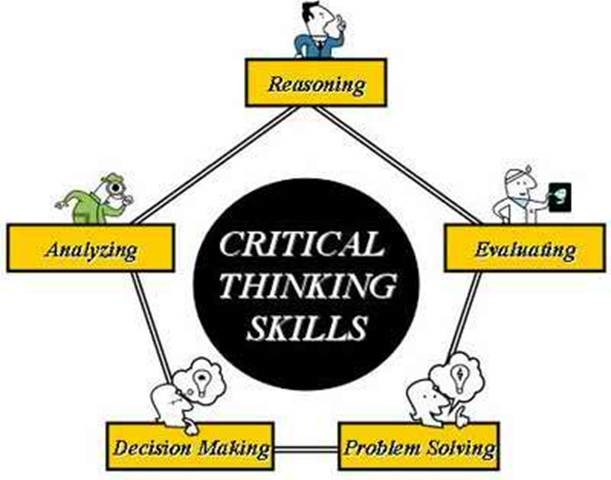
A social studies teacher in a public secondary school in Kaduna had always taught the causes of conflict by listing them on the board and asking students to copy and memorise them. Her students did well on recall tests and poorly on questions that asked them to explain, compare, or evaluate, the kind of questions that appeared in WAEC and NECO examinations.
She made one change. At the start of each unit, she began presenting a real-world conflict from Nigerian history or current events and asking students a single question before she taught anything: “What do you think caused this? Write three possible reasons.” Students discussed their ideas in pairs, then she taught the formal content and asked them to revisit their initial answers at the end of the lesson, identifying what they had got right, what they had missed, and what they would now add.
This single adjustment; prediction before instruction, revision after produced a measurable shift in her students’ ability to write analytical answers in class tests. They were no longer just remembering causes. They were thinking about causation itself and that is a different skill entirely.
Your action step this week
Take one question you would normally ask in this week’s lesson, one that currently invites a single correct answer from memory and upgrade it one level on Bloom’s taxonomy. Add “why do you think that is?” Add “what if X were different?” Ask students to argue the opposite side before defending their own view. You do not need to redesign the lesson. You need to change one question and then wait, in silence, long enough for a student to actually think before they answer. That silence is not emptiness. It is thinking happening, and it is exactly what a critical thinking classroom sounds like.