
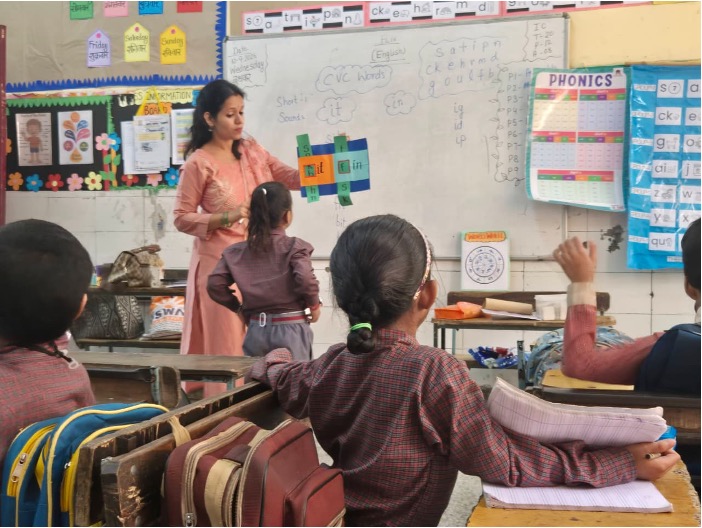
Engagement is not about keeping students entertained. It is about making them feel that what happens in your classroom matters, to them, right now.
Introduction

You know the look. That glassy, faraway stare that tells you a student is physically present but mentally somewhere else entirely. It is one of the most discouraging things a teacher can face, especially when you have worked hard to prepare a lesson.
But here is something important to understand: disengagement is rarely about attitude. More often, it is a signal. A signal that the lesson has not yet connected to something the student cares about, understands, or feels capable of contributing to. The moment that connection is made, everything shifts.
A busy classroom with large numbers, mixed abilities, limited resources, makes engagement feel harder than it should be. But the strategies below do not require extra money or extra time. They require a shift in how you think about your role. Instead of delivering a lesson, you are designing an experience.
| Average attention span 10 min before students need re-engagement | Retention with passive listening 5% vs. 75% when students teach each other | Impact of cold calling Low raises anxiety, not engagement |
Students do not disengage because they are lazy. They disengage because the lesson has not yet given them a reason to stay. – Adapted from motivational learning research
Five strategies that work
1. Use group work with clear roles
When students work in groups without structure, a few confident voices dominate and the rest drift. The fix is simple: assign roles. One student is the reader, one is the recorder, one is the reporter, one is the timekeeper. Everyone has a job. Everyone is accountable. This works in classes of 20 or 60 and it takes less than two minutes to set up. Rotate roles each week so no student gets stuck in one position.
Try it: Assign roles before your next group task and watch participation change.
2. Ask better questions
Questions that have one right answer invite one student to respond while the rest switch off. Questions that invite opinion, prediction, or interpretation keep more minds active. Instead of asking “What is the capital of Nigeria?”, try “Why do you think Abuja was chosen over Lagos as the capital?” Instead of “What happened next?”, try “What do you think should have happened?” Open questions do not require the teacher to have one right answer and that freedom invites even shy students to contribute.
Try it: Replace one closed question per lesson with an open “what do you think?” prompt.
3. Change the pace every 10 minutes
Research on attention spans consistently shows that most students can focus deeply for about 10 minutes before their concentration dips. This does not mean the lesson has to stop, it means the mode of engagement needs to shift. After 10 minutes of teacher-led instruction, move to 5 minutes of pair discussion. After another 10 minutes, try a quick written reflection. These transitions cost almost no time and dramatically reduce the drift you see in longer unbroken teaching segments.
Try it: Set a silent timer and shift activity mode every 10 minutes in one lesson this week.
4. Make learning visible
Students engage more when they can see their own thinking on display. Simple tools like mini whiteboards, sticky notes on the wall, or a class “idea board” on the chalkboard give students a reason to produce something and something to be proud of. Even just asking students to write one sentence on a scrap of paper and hold it up creates a sense of participation that is hard to replicate through verbal exchange alone. In a Lagos classroom without printed materials, the classroom wall itself can become a thinking space.
Try it: Ask students to write one key idea from today’s lesson on paper and pin it to the board.
5. Connect the lesson to real life
Nothing breaks engagement faster than a student thinking “when will I ever use this?” The solution is not to defend the curriculum, it is to build the bridge yourself. Before introducing a concept, spend 60 seconds showing how it shows up in everyday life in your community. Teaching fractions? Talk about how market traders divide goods. Teaching essay writing? Show how a well-argued letter can win a complaint with a government office. Relevance is the fastest route to attention.
Try it: Begin your next lesson with one real-world example from Lagos or your local community.
From a classroom in Lagos
A primary school teacher in Surulere had a class of 52 pupils and very little in the way of printed materials. She began using what she called “the 10-minute switch,” every 10 minutes, she shifted from speaking, to group discussion, to written work, and back again. She did not change her content. She changed the rhythm.
Within three weeks, she noticed that fewer pupils were resting their heads on desks. More hands were going up. Several pupils who had never spoken in class began contributing during the pair discussion segments. She had not added anything new to her classroom, she had re-organised what was already there.
Your action step this week
Pick one strategy from the five above and use it in your very next class. You do not need to plan anything elaborate. If you choose better questions, write three open questions before the lesson. If you choose the 10-minute switch, set a phone timer. Small, deliberate shifts build habits. And good habits, repeated consistently, transform classrooms.