

Abstract
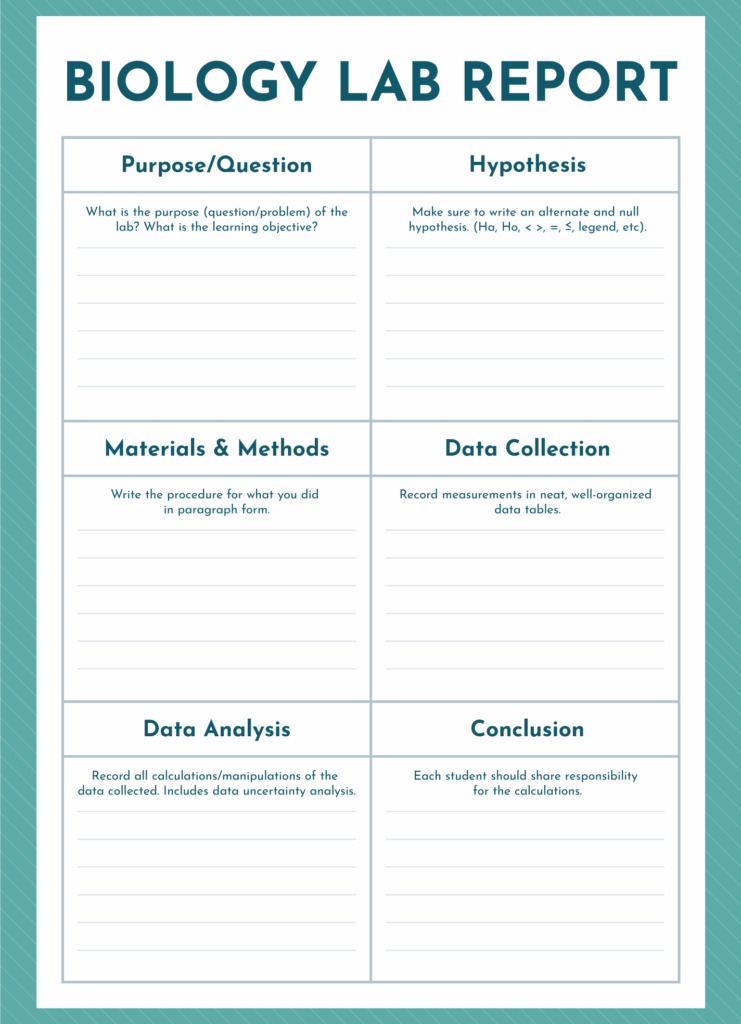
Laboratory reports constitute a fundamental component of undergraduate and graduate biology education, serving as the primary medium through which students demonstrate their understanding of scientific methodology, data analysis, and scientific communication. This comprehensive guide examines the essential elements of biology lab report writing, including proper formatting conventions, structural requirements, and practical examples that align with contemporary academic standards. Students must understand that effective lab report writing not only fulfills course requirements but also develops critical scientific writing skills essential for future research endeavors and professional scientific communication.
Introduction

The ability to communicate scientific findings clearly and accurately represents one of the most crucial skills biology students must develop throughout their academic careers. Laboratory reports serve multiple pedagogical purposes: they reinforce scientific methodology, develop analytical thinking skills, and provide practice in professional scientific writing conventions. Unlike informal writing assignments, biology lab reports follow specific formatting guidelines that mirror those used in professional scientific journals, thereby preparing students for advanced research and potential publication opportunities.
The significance of mastering lab report writing extends beyond academic success. Professional biologists, researchers, and healthcare professionals regularly produce technical documents that require the same precision, clarity, and adherence to formatting standards that students practice through lab reports. Furthermore, the analytical thinking required to interpret experimental data and draw meaningful conclusions directly translates to problem-solving skills valued across numerous career paths.
Standard Biology Lab Report Structure
Title Page and Header Information
Every biology lab report begins with a properly formatted title page that includes essential identifying information. The title should be concise yet descriptive, accurately reflecting the experiment’s focus without unnecessary verbosity. Standard title page elements include the experiment title, student name, course number and section, instructor name, and submission date. Many biology departments require specific formatting for these elements, including particular fonts, spacing, and alignment requirements.
The title itself deserves careful attention, as it represents the reader’s first impression of the work. Effective titles typically range from 8-15 words and include key variables or organisms studied. For example, “Effects of pH on Enzyme Activity in Catalase from Potato Extract” provides clear information about the experimental focus, while “Lab #3” offers no meaningful information about the content.
Abstract Section
The abstract functions as a comprehensive summary of the entire experiment, typically ranging from 150-250 words. This section must include four critical components: the research question or objective, methodology overview, key results, and primary conclusions. Writing an effective abstract requires students to distill complex experimental procedures and findings into clear, concise language that allows readers to understand the study’s scope and significance without reading the full report.
Students frequently struggle with abstract writing because it requires them to synthesize information from the entire experiment before writing other sections. However, many instructors recommend writing the abstract last, after completing all other sections, to ensure accuracy and completeness. The abstract should stand alone as a complete summary, meaning readers should understand the experiment’s purpose, approach, and outcomes without referring to other sections.
Introduction and Background
The introduction establishes the scientific context for the experiment and demonstrates the student’s understanding of relevant biological principles. This section typically begins with broad background information about the topic area, gradually narrowing to the specific research question addressed in the experiment. Students must cite relevant literature to support their background statements and demonstrate familiarity with current scientific understanding.
A well-crafted introduction concludes with a clear statement of the experimental objective and, when appropriate, a testable hypothesis. The hypothesis should be specific, measurable, and based on the background information presented earlier in the section. Students should avoid vague predictions and instead formulate hypotheses that can be directly tested through the experimental procedures described in the methods section.
Materials and Methods
The materials and methods section provides a detailed account of experimental procedures sufficient for replication by other researchers. This section should be written in past tense, using passive voice when appropriate, and organized chronologically or by procedure type. Students must include specific details about equipment, reagents, organisms studied, and environmental conditions while avoiding unnecessary information that does not affect experimental outcomes.
Effective methods sections balance completeness with conciseness. Students should include enough detail for replication while avoiding excessive description of standard laboratory techniques. For example, describing the specific concentration of buffer solutions is essential, while detailed explanation of basic pipetting techniques is typically unnecessary. Many instructors appreciate when students organize complex procedures into clearly labeled subsections.
Results Section
The results section presents experimental findings objectively, without interpretation or discussion of their significance. This section should include both narrative description of results and appropriate visual representations such as tables, graphs, and figures. Students must learn to distinguish between raw data presentation and data interpretation, reserving analysis and conclusions for the discussion section.
Tables and figures require careful attention to formatting conventions. Each visual element should include a descriptive caption that allows it to stand alone without reference to the text. Graphs should include appropriate titles, axis labels with units, and error bars when applicable. Students should refer to each table and figure in the text and briefly describe the information it contains without repeating all details shown in the visual element.
Discussion and Analysis
The discussion section represents the most intellectually demanding portion of the lab report, requiring students to interpret their results within the broader context of biological knowledge. This section should begin by stating whether the experimental results supported or refuted the initial hypothesis, followed by detailed analysis of the findings’ biological significance.
Students must demonstrate critical thinking by discussing potential sources of error, limitations of their experimental design, and alternative explanations for unexpected results. The discussion should also connect experimental findings to relevant biological principles covered in lectures or laboratory exercises. Strong discussions often conclude by suggesting future experiments that could extend or clarify the current findings.
References and Citations

Proper citation of scientific literature demonstrates academic integrity and allows readers to verify information sources. Biology courses typically require either APA or CSE (Council of Science Editors) citation formats, depending on departmental preferences and course requirements. Students must distinguish between primary sources (original research articles) and secondary sources (textbooks, review articles) and show preference for recent, peer-reviewed research when available.
Citation accuracy requires attention to numerous details including author names, publication dates, journal titles, volume numbers, and page ranges. Many students benefit from using citation management software to maintain consistency and accuracy across multiple assignments. However, students should verify that automated citations conform to required formatting standards, as citation tools sometimes contain errors or use outdated formatting conventions.
Formatting Guidelines and Best Practices
Font and Spacing Requirements
Most biology courses require standard academic formatting: 12-point Times New Roman or similar serif font, double-spacing throughout the document, and one-inch margins on all sides. These requirements ensure readability and provide space for instructor comments. Students should verify specific formatting requirements with their instructors, as some courses may have unique preferences or departmental standards.
Page numbering typically begins on the title page and continues throughout the document. Headers may include the student’s last name and course information, depending on instructor preferences. Consistent formatting throughout the document demonstrates attention to detail and professional presentation standards valued in scientific communication.
Scientific Writing Style
Biology lab reports require clear, concise writing that emphasizes objectivity and precision. Students should use past tense when describing completed procedures and results, while present tense is appropriate for discussing established scientific facts and ongoing phenomena. Active voice generally produces clearer, more direct sentences than passive voice, though passive construction may be appropriate when the focus should be on the action rather than the actor.
Technical terminology should be used accurately and consistently throughout the report. Students should define specialized terms upon first use and maintain consistent terminology rather than using synonyms for variety. Scientific writing values precision over stylistic flourishes, meaning students should prioritize clarity and accuracy over elaborate prose.
Data Presentation Standards
Effective data presentation requires careful consideration of the most appropriate format for different types of information. Numerical data with multiple variables often work best in table format, while trends over time or relationships between variables are typically better represented through graphs or charts. Students should choose visual formats that highlight the most important patterns in their data.
Graph construction follows specific conventions that students must master. Independent variables typically appear on the x-axis, while dependent variables are plotted on the y-axis. Error bars should be included when appropriate, with clear indication of whether they represent standard deviation, standard error, or confidence intervals. Color choices should ensure accessibility for colorblind readers, typically achieved through the use of different line styles or symbols in addition to color coding.
Common Formatting Examples
Sample Abstract
“This experiment investigated the effects of varying pH levels on catalase enzyme activity in potato extract. Catalase activity was measured by monitoring oxygen production rates at pH levels ranging from 4.0 to 10.0 using a gas pressure sensor. Results showed optimal enzyme activity at pH 7.0, with significant decreases in activity at both acidic (pH 4.0-6.0) and basic (pH 8.0-10.0) conditions. These findings support the hypothesis that catalase demonstrates maximum activity under neutral pH conditions, consistent with its physiological function in cellular antioxidant systems. The experiment demonstrates the importance of pH optimization in enzyme function and provides practical experience with quantitative enzyme assays.”
Sample Methods Excerpt
“Fresh potato tubers (Solanum tuberosum) were obtained from local suppliers and stored at 4°C until use. Potato extract was prepared by homogenizing 50g of peeled potato tissue in 100mL of distilled water using a standard laboratory blender for 2 minutes. The resulting mixture was filtered through cheesecloth and centrifuged at 3000 rpm for 10 minutes to remove cellular debris. The supernatant was collected and diluted 1:5 with distilled water to achieve appropriate enzyme concentration for activity measurements.”
Sample Results Description
“Catalase activity showed a clear pH-dependent pattern across the tested range (Figure 1). Maximum enzyme activity occurred at pH 7.0, producing 45.2 ± 3.1 mL oxygen per minute. Activity decreased significantly at acidic pH levels, with pH 4.0 producing only 12.8 ± 2.3 mL oxygen per minute. Similarly, basic conditions resulted in reduced activity, with pH 10.0 yielding 18.5 ± 4.2 mL oxygen per minute (Table 1).”
Critical Considerations and Common Pitfalls
Data Integrity and Accuracy
Students must maintain the highest standards of data integrity throughout the experimental process and report writing. This includes recording all observations accurately, reporting unexpected results honestly, and avoiding the temptation to modify data to match expected outcomes. Scientific integrity requires acknowledging when experiments do not proceed as planned and discussing potential reasons for unexpected results.
Common data presentation errors include inappropriate graph scales that distort visual relationships, missing error bars that prevent assessment of data reliability, and failure to include sufficient detail in figure captions. Students should carefully review all numerical data for transcription errors and ensure that calculations are performed correctly with appropriate attention to significant figures.
Literature Integration
Successful lab reports demonstrate the student’s ability to connect experimental findings with established scientific knowledge. This requires careful selection of relevant literature sources and appropriate integration of cited information throughout the report. Students should prioritize peer-reviewed research articles over general websites or textbooks when discussing specific research findings.
Citation errors represent one of the most common problems in student lab reports. These include incomplete bibliographic information, incorrect in-text citation formats, and failure to cite all sources referenced in the text. Students should develop systematic approaches to reference management early in their academic careers to avoid these persistent problems.
Time Management and Planning
Effective lab report writing requires substantial time investment that students often underestimate. The writing process should begin immediately after completing the laboratory exercise, while observations and procedures remain fresh in memory. Students benefit from creating detailed outlines before beginning to write and allowing sufficient time for revision and proofreading.
Many students struggle with the iterative nature of scientific writing, expecting to produce polished reports in single drafts. However, professional scientific writing typically requires multiple revisions to achieve clarity, accuracy, and appropriate organization. Students should plan to complete initial drafts well before deadlines to allow time for substantive revision based on careful review of content and formatting requirements.
Advanced Considerations for Upper-Level Courses
Statistical Analysis Integration
Advanced biology courses increasingly require students to perform statistical analyses of their experimental data and integrate these analyses appropriately into their lab reports. Students must understand when statistical tests are appropriate, how to interpret statistical results, and how to present statistical findings in both text and graphical formats.
Common statistical considerations include determining appropriate sample sizes, selecting suitable statistical tests for different data types, and interpreting p-values and confidence intervals correctly. Students should consult with instructors or statistical resources when uncertain about appropriate analytical approaches, as incorrect statistical analysis can invalidate otherwise well-designed experiments.
Professional Development Implications
Mastery of lab report writing provides foundational skills for numerous advanced academic and professional opportunities. Students planning graduate school will find that lab report writing directly prepares them for thesis writing, publication preparation, and research proposal development. Similarly, students entering professional careers often discover that technical writing skills developed through lab reports transfer directly to workplace documentation requirements.
The attention to detail required for proper lab report formatting develops habits of precision and thoroughness that prove valuable across numerous professional contexts. Students who consistently produce high-quality lab reports often find themselves better prepared for internship applications, research opportunities, and graduate school admissions that require demonstration of scientific communication skills.
Conclusion
Effective biology lab report writing represents a complex skill that requires integration of scientific knowledge, technical writing ability, and attention to formatting details. Students who approach lab reports as opportunities to develop professional communication skills, rather than mere course requirements, position themselves for success in advanced coursework and future careers.
The investment in mastering proper lab report formatting and writing conventions pays dividends throughout students’ academic and professional careers. As scientific communication becomes increasingly important in addressing global challenges, students who develop strong technical writing skills contribute to the broader scientific enterprise while advancing their own educational and career objectives.
Success in lab report writing requires consistent practice, attention to instructor feedback, and willingness to revise and improve writing based on evolving understanding of scientific communication standards. Students should view each lab report as an opportunity to refine their scientific writing skills while demonstrating their understanding of biological principles and experimental methodology.