Learn about data collection methods students often overlook but should consider. From focus groups to digital analytics, discover new ways to strengthen your academic research.
Introduction
When conducting academic research, one of the most important stages is data collection. The quality of your data directly influences the strength of your findings, conclusions, and recommendations. While most students are familiar with common methods like questionnaires, interviews, and surveys, there are several other data collection techniques that are often overlooked but can significantly improve the depth and originality of a project.
In this article, we will highlight data collection methods students rarely consider, explain their benefits, and show how they can be applied across different academic disciplines. By the end, you will understand how to expand your research toolkit and select the most appropriate method for your study.
Why Data Collection Matters
Data collection is the backbone of any research project. It ensures that:
- Your findings are based on evidence rather than assumptions.
- Your arguments are supported with credible information.
- Your conclusions contribute meaningfully to knowledge in your field.
Poor data collection methods often result in weak analysis and questionable research quality. By exploring underused techniques, students can add originality and strength to their academic work.
Commonly Used Data Collection Methods
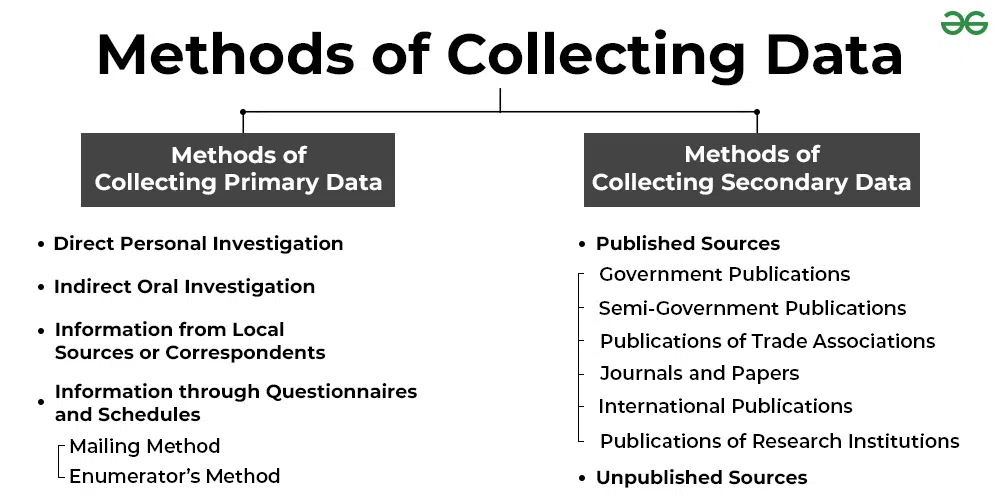
Before exploring the overlooked methods, let us briefly outline the most common ones:
- Surveys and Questionnaires: Widely used for gathering opinions from a large group.
- Interviews: Useful for collecting in-depth responses.
- Observation: Effective for behavioral or social research.
- Document/Content Analysis: Reviewing existing records, texts, or media.
These methods are effective but often over-relied upon, leading to repetitive or predictable projects.
Overlooked Data Collection Methods
1. Focus Group Discussions
A focus group discussion (FGD) involves bringing together a small group of participants to discuss a specific topic guided by a moderator.
Why it is overlooked: Many students assume interviews or surveys are enough, ignoring the value of group interaction.
Benefits:
- Participants exchange ideas and challenge each other, leading to richer data.
- Useful for exploring opinions, perceptions, and social dynamics.
- Allows researchers to identify consensus or diversity of views.
Example Application: A student researching the impact of social media on learning could organize a focus group of students to discuss their experiences and strategies.
2. Case Studies
A case study involves a detailed examination of a single subject, event, or institution over time.
Why it is overlooked: Students often consider it too narrow or time-consuming.
Benefits:
- Provides deep insights into real-life contexts.
- Useful for exploring rare phenomena.
- Allows the use of multiple sources of evidence (documents, interviews, observations).
Example Application: A business student might analyze one company’s approach to crisis management to provide practical insights.
3. Experiments
Experiments involve testing hypotheses under controlled conditions to observe cause-and-effect relationships.
Why it is overlooked: Many students think experiments are only for natural sciences.
Benefits:
- Establishes causal relationships between variables.
- Enhances reliability and validity through control.
- Provides measurable and replicable results.
Example Application: A psychology student might test whether background music influences students’ concentration levels.
4. Longitudinal Studies
This method involves collecting data from the same subjects repeatedly over a long period.
Why it is overlooked: It requires patience, consistency, and extended timelines.
Benefits:
- Tracks changes and trends over time.
- Useful for studying development, growth, or long-term effects.
- Provides more comprehensive insights than cross-sectional studies.
Example Application: An education student might track how study habits evolve among first-year students until their final year.
5. Secondary Data Analysis
Secondary data analysis involves using existing data collected by other researchers, organizations, or institutions.
Why it is overlooked: Students often assume originality means only collecting new data.
Benefits:
- Saves time and resources.
- Provides access to large datasets not possible to collect individually.
- Allows comparative or historical analysis.
Example Application: An economics student may analyze government statistics on employment rates instead of conducting primary surveys.
6. Delphi Technique
The Delphi technique involves consulting a panel of experts through multiple rounds of questionnaires until a consensus is reached.
Why it is overlooked: It is less known outside professional or policy-related research.
Benefits:
- Gathers expert opinions systematically.
- Useful for forecasting trends and solving complex problems.
- Reduces bias by using anonymity among experts.
Example Application: A public health student could use this method to forecast the future challenges of healthcare delivery in rural areas.
7. Content and Discourse Analysis
Content analysis involves systematically analyzing texts, media, or documents, while discourse analysis studies how language is used in communication.
Why it is overlooked: Students often see it as vague or too theoretical.
Benefits:
- Provides insights into media, communication, and cultural patterns.
- Useful for analyzing speeches, advertisements, or social media content.
- Helps in identifying hidden meanings or biases in texts.
Example Application: A communication student could analyze political speeches to identify persuasive techniques.
8. Ethnography
Ethnography is an in-depth study of people and cultures in their natural settings.
Why it is overlooked: Students assume it is too complex or requires living in the field.
Benefits:
- Provides deep cultural and social insights.
- Useful for anthropology, sociology, and education studies.
- Captures behaviors and meanings from the participants’ perspectives.
Example Application: An education student might spend time in a rural school to study teaching methods and student interactions.
9. Online Analytics and Digital Traces
In the digital era, online platforms provide valuable data through analytics and digital footprints.
Why it is overlooked: Many students do not consider social media or website data as valid academic sources.
Benefits:
- Provides real-time, large-scale data.
- Useful for analyzing trends, behaviors, and preferences.
- Accessible and often cost-effective.
Example Application: A marketing student could analyze website traffic or social media engagement to understand consumer behavior.
How to Choose the Right Data Collection Method
When selecting a data collection method, consider:
- Nature of your research problem: Is it exploratory, descriptive, or experimental?
- Time and resources available: Do you have enough access and budget?
- Type of data needed: Qualitative, quantitative, or both?
- Ethical considerations: Is the method appropriate and respectful to participants?
No single method is universally best. The choice depends on the research question and objectives.
Common Mistakes Students Make in Data Collection
- Choosing a method simply because it is common or easy.
- Ignoring alternative methods that could produce richer data.
- Collecting excessive data without a clear focus.
- Neglecting ethical approval or participant consent.
- Failing to justify why a particular method was chosen.
Conclusion
Data collection is more than filling out surveys or conducting interviews. By exploring overlooked methods such as focus groups, case studies, experiments, longitudinal studies, and digital analytics, students can bring originality and depth to their research.
Selecting the right method requires understanding your research question, resources, and academic discipline. Ultimately, using diverse data collection strategies not only strengthens your thesis but also improves your credibility as a researcher.